
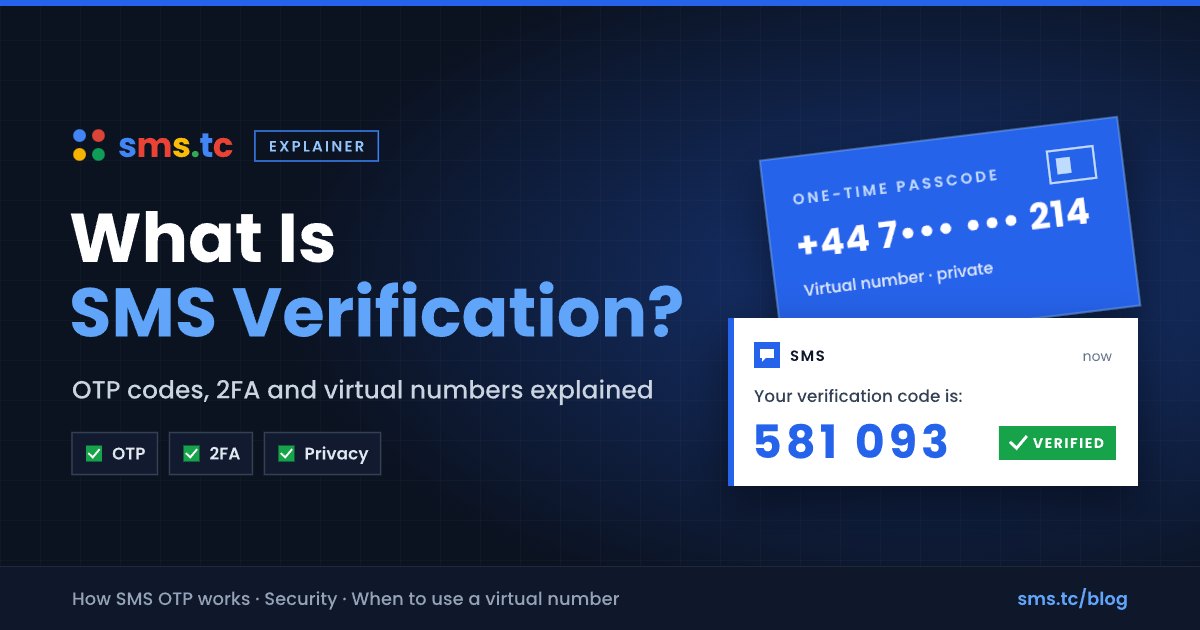
Quick answer: What is SMS verification? It is a security step in which a website or app sends a one-time code (OTP) to your phone by text message, and you type the code back to prove you control that number. It is used to confirm new accounts, as a second factor at login (SMS 2FA), and for account recovery. SMS verification is convenient and better than a password alone, but it is weaker than authenticator apps or passkeys because texts can be intercepted through SIM-swap attacks.
What Is SMS Verification?
SMS verification (also called SMS OTP, SMS authentication, or phone verification) links an online account to a phone number. The service generates a random code, usually 4 to 8 digits, sends it to the number by text message, and asks you to enter it within a few minutes. If the code matches, the number is marked as verified.
The goal is simple: make it harder to create fake accounts in bulk and harder for attackers to sign in with a stolen password alone.
How Does SMS OTP Work? Step by Step
- You enter your phone number on a website or app.
- The service generates a random one-time code and stores it for a short time (often 5-10 minutes).
- The code is sent through an SMS gateway and the mobile carrier network to your phone.
- You enter the code on the website or app.
- The service checks the code, marks the number as verified, and discards the code.
Many services also check the type of number before sending a code. That is why SMS verification sometimes fails even when the phone itself works fine. Some reject VoIP numbers or numbers that have been used on too many accounts.
Where Is SMS Verification Used?
| Use case | What it protects | Examples |
|---|---|---|
| Account registration | Stops bulk fake sign-ups | Instagram, WhatsApp, Telegram |
| Two-factor authentication | Adds a second step at login | Google, TikTok, banks |
| Account recovery | Proves ownership after a lost password | Most social and email services |
| Transaction confirmation | Confirms payments or changes | Banks, wallets, marketplaces |
| Feature unlocks | Limits abuse of powerful features | YouTube intermediate features |
Is SMS Verification Secure?
SMS verification is much better than a password alone, but it is not the strongest option:
| Method | Security level | Main weakness |
|---|---|---|
| SMS code | Medium | SIM swap, interception, phishing |
| Voice call code | Medium | Same as SMS |
| Authenticator app (TOTP) | High | Phishing if you type the code on a fake site |
| Passkey / security key | Very high | Requires supported devices |
For important accounts such as email and banking, add an authenticator app or passkey and keep backup codes in a safe place. Never share a verification code with anyone - legitimate support staff will not ask for it.
What Is a Virtual Phone Number?
A virtual phone number is a number you rent online instead of buying a SIM card. You see incoming texts in a web dashboard. There are two very different kinds:
- Public "free SMS" numbers - shared on websites where anyone can read every message. They are overused and often blocked by apps.
- Private virtual numbers - the number and its SMS are visible only to you during the activation or rental. sms.tc numbers are carrier-issued mobile numbers rather than VoIP lines, so they work for most services; acceptance varies by country.
When Does a Virtual Number Make Sense?
- Privacy - keep your personal number away from marketing lists and data leaks.
- Separate lines - a dedicated number for a small business or side project.
- Travel - receive a code for a country where you do not have a SIM.
- Testing - developers testing their own sign-up flows, for example through an SMS verification API.
How to Verify an Account with sms.tc
- Create a free account at sms.tc and add a small balance.
- Open SMS Activation and search for the service (50+ popular services are listed).
- Pick a country from 100+ options; prices start from a few cents.
- Click Buy Number to receive a private number.
- Enter the number on the website or app that asks for verification.
- The code appears on your sms.tc order page, usually within 10-60 seconds.
- Paste the code to finish. If nothing arrives, cancel - you are not charged.
For accounts that will need codes again later, use a rental number.
Verification Code Not Received? 6 Common Causes
- Wrong country code or an extra leading zero.
- VoIP or public number rejected by the service.
- Number already used too many times on that service.
- Rate limits after repeated "resend" requests.
- Carrier spam filters on your own phone.
- In-app delivery - some apps (like Telegram) send the first code to an existing session.
Use Virtual Numbers Responsibly
Virtual numbers are privacy tools, and SMS verification exists to stop abuse. Follow each platform's terms: respect one-account-per-person rules where they apply, and never use numbers for spam, fraud, or to get around a ban.
Frequently Asked Questions
What is SMS verification used for?
SMS verification is used to confirm new accounts, add a second factor at login, recover accounts, and confirm sensitive actions such as payments. SMS verification proves you control a specific phone number.
What does OTP mean in SMS verification?
OTP means one-time password: a short code that works only once and expires after a few minutes. An SMS OTP is a one-time password delivered by text message.
Is SMS verification safe?
SMS verification is safer than a password alone, but SMS codes can be stolen through SIM swapping or phishing. For high-value accounts, combine SMS verification with an authenticator app or a passkey.
Can I do SMS verification without a SIM card?
Yes. A private virtual number lets you receive SMS verification codes in a web dashboard without a SIM card. Services like sms.tc provide carrier-issued mobile numbers for this.
Why do some websites reject my number?
Websites reject numbers during SMS verification when the number is VoIP, publicly shared, already linked to too many accounts, or from an unsupported country. Using a fresh private mobile number usually solves the problem.
How long is an SMS verification code valid?
An SMS verification code is usually valid for 5 to 10 minutes, depending on the service. After that, request a new code.
Key Takeaways
- SMS verification sends a one-time code to prove you control a phone number.
- It is convenient but weaker than authenticator apps and passkeys.
- Private virtual numbers work far better than public free SMS sites.
- sms.tc offers private numbers for 50+ popular services in 100+ countries.
Create your free sms.tc account - receive your first verification code in minutes.